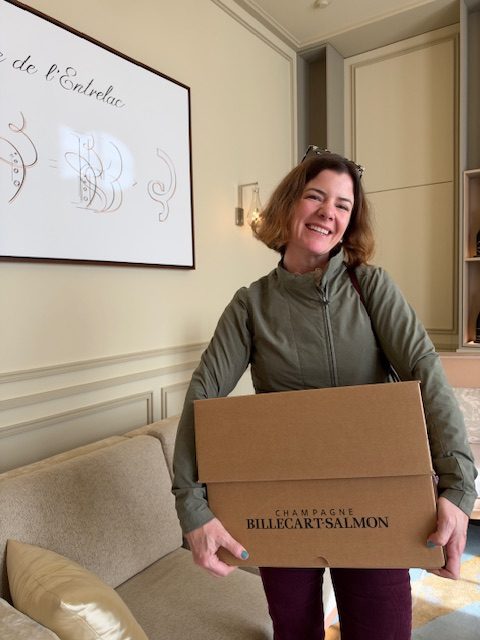


Our second day in Champagne featured our most anticipated champagne tour: Billecart-Salmon! Jyostna loves this champagne house and for very, very good reason. It’s so delicious! It is hard to get a tour reservation. I tried via email and I’m still waiting for a response. Jyotsna wrote a flowery email about how Billecart-Salmon champagne has marked many significant life events for her. She had a confirmation the next day!


Billecart- Salmon tour
They have several well-known bottles, including their Rosé. A new-to-us but very well-known in the wine world is their flagship Clos de Saint Hilaire from a vineyard where the vines are 62 years old. This gives great flavor with the trade-off being low yields from these old pinot noir vines. The vineyard is cultivated using biodynamic methods including work horses for soil tilling and sheep for natural grazing. They do not, however, bury cow horns filled with manure. Le cuvee (first press) is aged 5 months in oak, when the “tasting committee” makes the decision as whether to bottle as a vintage or not. They average a vintage every other year. If it’s determined to not be good enough for vintage, then it is saved to blend into the non-vintage champagnes. If they bottle it, they tend to get ~3000 bottles (sometimes higher).
Billecart uses oak barrels for the first fermentation, but more for the gentle micro-oxidation rather than seeking oak notes. In fact, because they prize a delicate flavor, they actually use the oak barrels for the la taille (second press) storage for 5 years to get rid of the new oak effect. Then they use the barrels for primary fermentation for the next 20 years.
For the non-vintage, they mix from the first fermentation with an approximate ration of 20/80, oak/steel.
They use a cold fermentation (55F) technique that the started ~5 years ago. The winemaker feels this preserves the delicacy even though it takes quite a bit longer (six weeks vs 10-14 days with conventional method).

This past August (2026) was the earliest harvest ever. Typically, the vintners count on harvest-ready grapes 100 days from the initial flowering. This year, it was 83 days. It ruined a lot of vacations since people had to come back- part of the AOC rules is that harvest is done by hand if it is to meet the criteria for Champagne.


There were a few barrel rooms that were pretty magnificent. Apparently, one guy is in charge of the entire room. He writes out the room contents on a blackboard in the most beautiful script.


There are Burgundy size barrels made of French oak and regular size made out of Hungarian oak. The large barrels (50) can hold 8000 liters each. There are 2043 small barrels.

In the middle are the Clos de Sainte Hilaire, not all of which are full. This wine is so limited that most of it goes to “high gastronomie” restaurants around the world.

Towards the end of the tour, we went by the “nursery” where various steel tanks hold different options for the dosage. The tour guide said this was “the last touch of the winemaker,” which sounds so poetic. It consists of the Liqour d’expistion (wine and sugar), which is different from and in addition to the dosage.


We saw the bottle room for the clos, which is located directly under the large oak that was seen earlier in the beautiful private garden.


We then had our wine tasting, which was excellent: one non-vintage and two vintages.
I would say the saddest thing I learned through these tours is that my preference in champagne runs expensive (*cue crocodile tears). Not only do I think these high end champagnes are delicious, but the complexity of the later-disgorged vintage years is phenomenal.

After the tour, we were so happy. It was another beautiful day and we had just had an incredible tour.

Biking in Champagne
We had talked about biking around Champagne and we decided to make it happen! The hotel concierge said he thought bikes could be delivered immediately, but Jyotsna and I decided to go into town and get them ourselves. Although service had been exemplary through the trip, speed was not a defining feature.

We picked up our bikes, spent a little too long talking to the bike shop guy about possible routes through a new-to-me app Komoot, and took off. I ended up using the trusty GeoVelo. Apart from a few kilometers on D9 (at least it wasn’t rush hour), we rode back roads/vineyard access roads.

There was a little bit of adventure with some mud and one section of big rocks, but we navigated it with aplomb.
We rode to Avises and did the whole “knock on small growers doors for tastings if they’re open.” Well, one problem with this technique is when multiple growers say they’re full or not open. So, be prepared to hear no.

But since our thirst was unquenched, we went to the next village where several small producers are featured in a wine shop/tasting room called La Champagnothèque. We each had a flight, shared a cheeseboard, and then headed back to the bike shop. About halfway back, my chain dropped completely off the derailer. And, unfortunately, the e-bike had a huge cover that prevented me from getting it back on place.
Fortunately, we could continue on because I could ride the bike like a moped. Although I really wanted to peddle, I didn’t want to wait for help from the bike shop SOS QR code response.

Overall, the bike ride was fantastic. I recommend GeoVelo. If you follow the “Safer” route option, it’s often a little longer but more side roads rather than putting you on secondary highways, which can feel a bit dangerous.

Evening in Épernay
We took the bus into Epernay, since the bike shop was actually in Ay-Champagne. We walked down the Avenue de Champagne, which was less Disneyland than I thought. Instead, it was beautiful avenue flanked by large in-use buildings of different champagne houses. It included beautiful chateaus, but there were some production buildings so it wasn’t all targeted to tourist wine experiences. It’s a working street!


There are bars, though. We stopped by for a quick drink at L’Ecurie at Champagne de Venoge. They were closing, but “didn’t want to turn us away” so we grabbed a glass of Princes Blanc de Noir. It was great!

We went to Comptoir des Vignerons de Champagne for oysters and champagne. There were few oyster options in Épernay and we wanted to have some. It was ok- nothing terrible, but average from both the oyster and champagne perspective.

For dinner, we went into town and ate at the Sacré bistro. Jyostna had salmon and I had the burger, which was quite good! I had a glass of extra brut champagne, which was quite nice. A brut Philipponnat was on the menu which in retrospect, I wish I tried since it’s another well-known champagne house from Billecart-Salmon town (Mareuil-sur-Ay). Also, brut/extra brut note: brut is <12 g/l while extra brut has to be <6 g/l but if a house has two champagnes that are < 6 g/l, they could call the one with the higher value brut rather than extra brut as a differentiator, even if it meets the Champagne AOC criteria of <6 g/l.

Our dessert was an apricot digestif, which was quite tasty.
We took an Uber back to the hotel, which was convenient and an inexpensive way to get around $15-$20.
What an amazing time you had in Champagne! That tour you took sounds amazing. I have never heard of that particular champagne, it sounds AMAZING.
I had more Billecart yesterday at a K&L event in SF. It is so delicious!